How Road–Rail combinations are redefining Europe’s freight future
Across Europe, fleet managers are facing growing pressure to cut emissions and navigate rising congestion and driver shortages. One solution is becoming increasingly clear: integrating road and rail into a seamless, intermodal strategy. While road remains the backbone of our customers’ operations, intermodal transport is becoming increasingly strategic.
At TIP Group, we’re seeing firsthand how combining the flexibility of road with the long distance efficiency of rail is reshaping fleet operations. Intermodal ready trailers are unlocking new possibilities for long haul transport, while rail helps reduce exposure to fuel volatility. At TIP, we are investing in intermodal ready equipment, we work closely with our customers and equipment partners to ensure we are ready for this shift.
But to fully realize Europe’s intermodal potential, fleets must be supported by fair and future-ready regulations. Current VECTO methodologies risk penalizing heavier, crane ready trailers, counterproductive for combined transport and decarbonization ambitions. TIP is actively advocating for regulatory changes that protect intermodal competitiveness.
To understand what this shift means for fleets, we spoke with Rogier Laan, Vice President Marketing & Sales at TIP Group.
What advantages do road–rail combinations bring to today’s logistics networks?
Road–rail combinations bring together the strengths of two highly complementary modes. Road offers flexibility and accessibility, while rail provides long‑distance efficiency and lower carbon intensity. For shippers, this results in more predictable transit times, reduced exposure to road congestion, and a logistics network that is both resilient and future‑proof. Events such as Truck2Rail, where TIP participated to demonstrate practical solutions for non‑cranable trailers, show that the industry is moving toward scalable, commercially viable intermodal deployments.
What barriers still prevent wider adoption of combined transport?
Challenges remain around rail infrastructure capacity, network maturity, and standardization, topics frequently raised by transport operators. While many fleets are rail‑compatible, the actual use of rail is often constrained by infrastructure limitations and bureaucratic hurdles. Standardizing equipment and ensuring seamless handovers between modes are crucial steps still requiring industry‑wide collaboration.
How does combined transport outperform road‑only operations?
Combined transport delivers clear environmental advantages, notably lower CO₂ emissions, reduced dependency on long‑haul trucking amid ongoing driver shortages. It also leads to improved cost predictability on long corridors and reduces wear on road networks. TIP’s initiatives in promoting intermodal solutions for standard and non‑cranable trailers highlight the growing practicality of shifting road‑based assets into hybrid operations.
Is road–rail integration set to become a cornerstone of Europe’s logistics future?
It will be a major pillar of Europe’s logistics future. The shift is supported by EU decarbonization policies, rail corridor investments, and increasing interest from shippers seeking more sustainable supply chains. We foresee increased multimodal usage in the next years driven by environmental obligations and structural driver shortages.
However, road transport will remain vital for first‑ and last‑mile operations, meaning the future is not “rail instead of road,” but a seamless integration of both.
What is driving the recent momentum in intermodal transportation?
The availability of equipment designed for multimodal compatibility is creating momentum, especially with new ways for non‑cranable trailers to be transported by rail. Regulatory incentives, sustainability goals, and customer demand for lower‑carbon logistics further accelerate adoption.
What cost efficiencies can fleets expect from intermodal operations?
- Lower line‑haul costs on long stretches when shifting from road to rail
- Reduced exposure to fuel price volatility
- Lower maintenance costs due to fewer long‑distance road kilometers
- Greater operational continuity in congested regions
How does combined transport support EU emissions targets and what risks are emerging?
Rail emits significantly less CO₂ per tonne‑kilometre than road, making combined transport one of the most impactful levers for meeting EU emissions compliance.
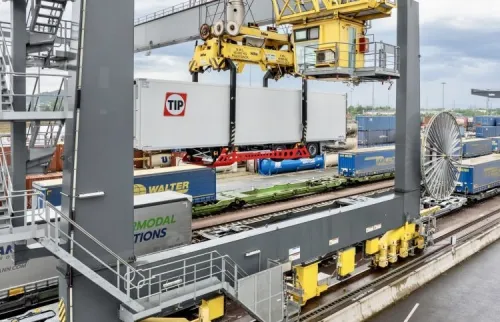
Moreover, it is critical to highlight the growing threat posed by the current VECTO methodology for trailers. Related to the forthcoming VECTO for trailers EU regulation. VECTO strongly penalizes weight while rewarding aerodynamic features. This creates a substantial problem for intermodal cranable (huckepack) trailers, which are naturally heavier due to their reinforced structure and crane pockets. At the same time, aerodynamic add‑ons, favoured by VECTO, are neither practical nor desirable for intermodal operations, as they do not fit safely on railway wagons and risk severe damage. The result is a structural disadvantage for cranable (huckepack) trailers within VECTO calculations. If unaddressed, this could make cranable (huckepack) trailers prohibitively expensive, undermining the competitiveness of combined transport.
Critically, such a development would incentivize a modal shift away from rail and back towards road transport, exactly the opposite of EU decarbonisation ambitions. For this reason, the European Transport Board is strongly advocating for the exclusion of cranable (huckepack) trailers from VECTO, ensuring they are not unfairly penalised and that intermodal transport can continue to contribute meaningfully to EU climate targets.
Is the rise of road–rail transport a temporary trend or a long-term shift?
It is a long‑term structural shift, not a temporary trend. Fleets expect multimodal usage to rise due to regulatory pressure, environmental priorities, and driver scarcity.
Combined transport strengthens European logistics by increasing capacity, reducing emissions, and enhancing resilience. Rather than replacing road transport, it reinforces the sector by ensuring it remains viable in a decarbonizing economy.
How is TIP Group supporting customers in this transformation?
While road remains the backbone of our customers’ operations, intermodal transport is becoming increasingly strategic. At TIP, we work closely with our customers and equipment partners to ensure we are ready for this shift. By advancing intermodal‑ready equipment across Europe, we support our customers in accelerating their sustainability goals while keeping their operations running smoothly.
TIP continuously invests in making its trailer fleet more intermodal‑capable and is actively supporting the shift to intermodal logistics through:
- Customer education and on‑site demonstrations of intermodal‑ready trailer solutions
- Engagement through the European Transport Board to advance EU‑level improvements in transport efficiency and sustainability