When two industry leaders join forces, refurbishment becomes a smart fleet strategy
As Europe’s transport and logistics sector faces mounting pressure to cut costs, reduce emissions, and maintain uptime, trailer refurbishment is emerging as a strategic solution rather than a secondary alternative. What was once viewed primarily as a budget-driven choice is now being redefined as a cornerstone of sustainable fleet management—driven by collaboration between industry leaders such as BPW and TIP Group.
Across the continent, fleet owners are rethinking how they manage assets that are seven, eight, or even ten years old. Instead of automatically replacing ageing trailers with new equipment, many operators are turning to structured refurbishment programs that extend service life, reduce capital expenditure, and lower carbon emissions.
At the centre of this shift stands TIP Group, one of Europe’s leading full-service equipment solutions providers, working closely with BPW, a global specialist in running gear, braking systems, and intelligent transport solutions.
The Strategic Case for Refurbishment
Refurbishment at TIP is built around what the company describes as an “age reset”. Rather than allowing trailers to depreciate toward obsolescence, the process restores them technically and cosmetically to a condition comparable to new—while avoiding the financial and environmental burden of replacement.
The economic case is compelling. New trailer prices have risen significantly in recent years, driven by material costs, supply chain disruptions, and regulatory complexity. For operators managing hundreds or thousands of units, full fleet renewal can require substantial capital outlay. Refurbishment, by contrast, offers a lower upfront investment while maintaining operational capability.
Beyond cost savings, the sustainability argument has become equally powerful. TIP has calculated that refurbishing a trailer can save up to 3.9 tonnes of CO₂ compared to purchasing a newly manufactured equivalent. In an era where ESG reporting, Scope 3 emissions, and corporate sustainability commitments shape procurement decisions, that measurable reduction carries real weight.
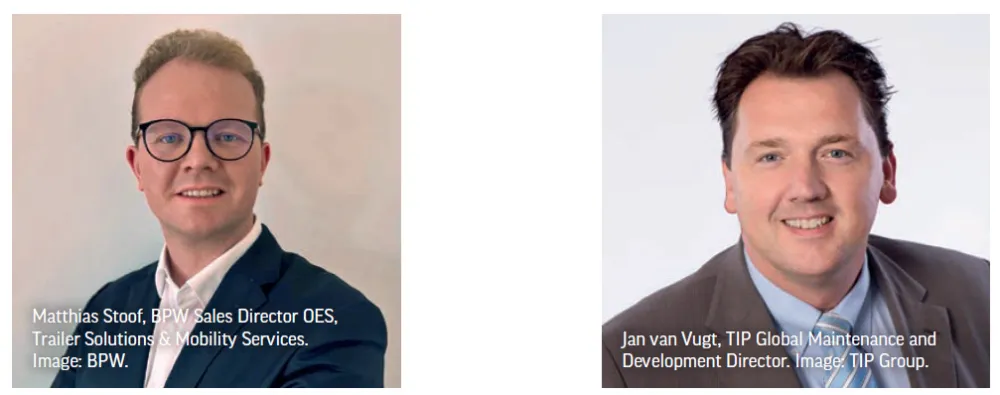
TIP Global Maintenance and Development Director, Jan van Vugt, explained the broader context: “Many of our customers are under pressure to keep fleets reliable while managing costs more carefully and reducing their carbon footprint. Refurbishment helps address all three.”
By working closely with leading industry partners like BPW, we can build refurbishment programs on proven components and real data – giving customers a clear, credible business case and equipment they can rely on for the long term. This is where refurbishment really makes a difference,” he added.
Two Models, One Objective
TIP has developed two primary refurbishment pathways to meet differing customer needs.
The first, Refurb & Lease, allows customers to lease refurbished TIP trailers at competitive rates, gaining access to renewed equipment without ownership burdens. The second, Sale & Leaseback, enables companies to sell their existing trailers to TIP, have them refurbished, and then lease them back—freeing capital previously tied up in fleet assets.
This flexibility is critical in a market where liquidity, asset optimisation, and financial prudence are paramount. Sale & Leaseback in particular has gained traction among operators seeking to strengthen balance sheets without compromising operational continuity.
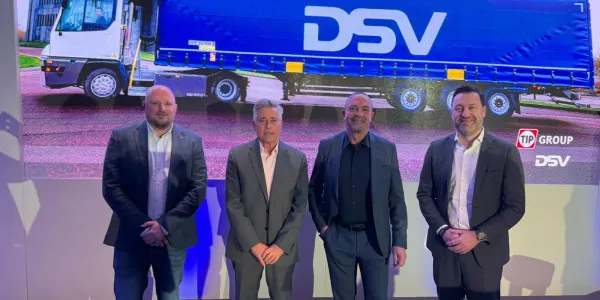
In recent years, TIP has delivered refurbishment projects for major logistics players including DSV, Howdens, and P&O Ferrymasters, demonstrating that refurbishment is not limited to small fleets but has become mainstream among global operators. (https://www.tip-group.com/en/refurbishment)
When Refurbishment Is Not the Answer
Despite its advantages, refurbishment is not universally appropriate. Each trailer undergoes a cost-benefit analysis before entering the program. Vehicles that have experienced extreme loads, structural damage, or excessive wear may prove too expensive to restore. In such cases, replacement with new equipment may remain the more rational decision. This disciplined evaluation process ensures that refurbishment remains economically viable and technically sound, rather than becoming a compromise solution.
The BPW Contribution: Beyond Axles
While TIP leads the refurbishment execution across its network of 130-plus European workshops, BPW provides the technical backbone for running gear and braking upgrades. Contrary to the common perception that BPW focuses solely on axles, the company’s portfolio extends much further.
“Our portfolio in the BPW Group includes axles, suspensions, brake systems and intelligent solutions such as tyre pressure refill systems, telematics, lighting systems and body hardware components,” said BPW Sales Director OES, Trailer Solutions & Mobility Services, Matthias Stoof.
This breadth allows refurbishment to become an opportunity for modernisation. Even trailers that were not originally equipped with smart systems can be upgraded during refurbishment to integrate seamlessly into modern fleets. “In principle there is always the possibility of equipping these trailers with new intelligent functions like telematics as well as economic and sustainable products during the refurbishment process,” said Stoof.
Meeting Modern Efficiency and Emissions Expectations
Unlike trucks, trailers do not have engines—but they still influence fuel consumption and emissions significantly. Weight, rolling resistance, tyre pressure, and braking efficiency all affect the tractor unit’s CO₂ output.
Lightweight running gear systems such as BPW’s Airlight II reduce trailer mass, increasing payload while lowering diesel consumption. Automatic tyre pressure systems like BPW AirSave maintain optimal pressure, reducing fuel use and tyre wear. Axle lift systems minimise rolling resistance when trailers run partially loaded.
“Every trailer can be modified to make them more energy efficient,” said Stoof. “Using lightweight running gears can reduce gross weight, lowering diesel consumption and increasing payload. Installing an axle lift system is very effective in reducing rolling resistance and thus lowering the tractor unit’s CO₂ emissions.” These upgrades demonstrate how refurbishment can actively improve environmental performance rather than merely extend service life.
Genuine Quality and the Reman Line
A cornerstone of the BPW–TIP collaboration is the consistent use of OEM-quality components. BPW primarily supplies genuine parts manufactured to original equipment specifications, ensuring durability, safety, and compatibility. “In a market with huge quality variations, we deliberately choose 100 per cent OEM standards – because our common customers measure us by uptime, safety and total costs of ownership,” said Stoof.
In addition to new genuine components, BPW has introduced its Reman Line—industrially remanufactured parts such as brake calipers that offer OEM-equivalent functionality with lower environmental impact. Remanufacturing reduces resource consumption while supporting fair-value repairs for older trailers.
“The use of remanufactured components like the BPW Reman brake caliper is another logical step towards making the refurbishment process even more climate-efficient,” Stoof added. Additional remanufactured products, including the BPW Reman Wheelend, are set to follow.
Process and Execution
The refurbishment process begins with a joint cost-benefit analysis involving the customer, TIP, and BPW. Typical candidates are van, curtainsider, or chassis trailers between seven and ten years old.
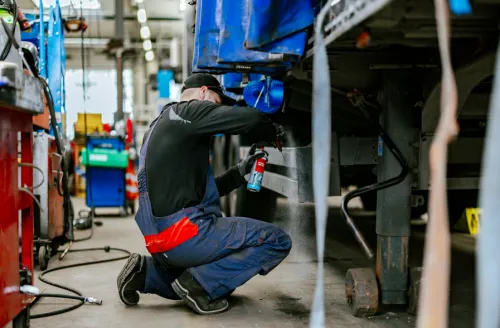
Refurbishment scope can range from cosmetic updates—fresh paintwork, new curtains, reflective tape, and signage—to technical interventions including axle replacements, suspension upgrades, and brake system renewals.
Full overhauls may replace all critical components, including flooring and structural elements. Pre-assembled, precisely greased BPW wheelends minimise workshop time, increasing trailer availability. Once refurbishment is complete, TIP coordinates vehicle logistics to ensure timely return to operation.
Compared to the extended lead times currently affecting new trailer production—sometimes up to a year—refurbishment typically requires only a few months, depending on scope.
Doubling the Lifecycle
One of the most compelling aspects of refurbishment is lifecycle extension. A full overhaul can effectively double a trailer’s operational life. The second lifecycle may last four to eight additional years, particularly when genuine parts are used. Stoof emphasised BPW’s broader vision. We see ourselves as a lifecycle partner throughout the entire vehicle usage – also with a view to the second service life. Using digital solutions such as telematics and digital maintenance functions, we will turn maintenance and refurbishment into a smart, data-driven lifecycle service.”
This shift toward predictive maintenance and digital integration aligns refurbishment with the future of connected fleet management.
Market Evolution in Europe
The European refurbishment industry is undergoing structural transformation. What was once considered a secondary, cost-driven segment is becoming professionalized and industrialised.
“The refurbishment industry in Europe is evolving from a cost-driven alternative market to a strategic component of industrial value creation,” Stoof said. “In the next years we can expect strong market growth, professionalisation, standardisation and industrialization as refurbishment becomes a competitive factor for sustainability, costs and resilience.”
For BPW, circular economy principles open opportunities for new business models and job creation. For TIP, refurbishment strengthens customer relationships and reinforces its role as a full-service equipment solutions partner.
Customer Response
Feedback from operators has been overwhelmingly positive. Customers report improved reliability, fewer unplanned service interruptions, and more predictable maintenance expenses. The proactive replacement of critical components extends intervals between repairs and enhances uptime.
Van Vugt highlighted the collaborative advantage: “By combining TIP’s refurbishment expertise with BPW’s technical know-how and genuine parts quality, we create reliable, future-proof solutions.”
Stoof reinforced the sustainability imperative: “Refurbishment is one of the most practical sustainable strategies available today,” he said. “Extending trailer lifecycles while reducing CO₂ emissions is not theory – its measurable impact. In a market with huge quality variations, we deliberately choose 100 per cent OEM standards – because our common customers measure us by uptime, safety and total costs of ownership.
“Refurbishment is one of the most practical sustainable strategies available today. Extending trailer lifecycles while reducing CO₂ emissions is not theory – it’s measurable impact.”
Looking Ahead
Both companies intend to deepen their partnership as refurbishment becomes a strategic pillar of European fleet management. The shared objective is to set benchmarks for sustainable fleet renewal, integrating technical excellence with environmental responsibility.
In a market defined by volatility, cost pressure, and regulatory change, refurbishment offers resilience. It preserves capital, reduces emissions, and ensures operational continuity—all while maintaining OEM-level quality and safety.
As circular economy principles gain traction across industries, trailer refurbishment stands out as a tangible, scalable example of sustainability in action. Through long-standing collaboration built on trust and technical rigor, BPW and TIP are not merely extending the life of trailers—they are redefining how fleets think about value, performance, and responsibility in the years ahead.
👉 Connect with our experts to find out which solution fits your needs: https://www.tip-group.com/en/refurbishment/get-in-touch